
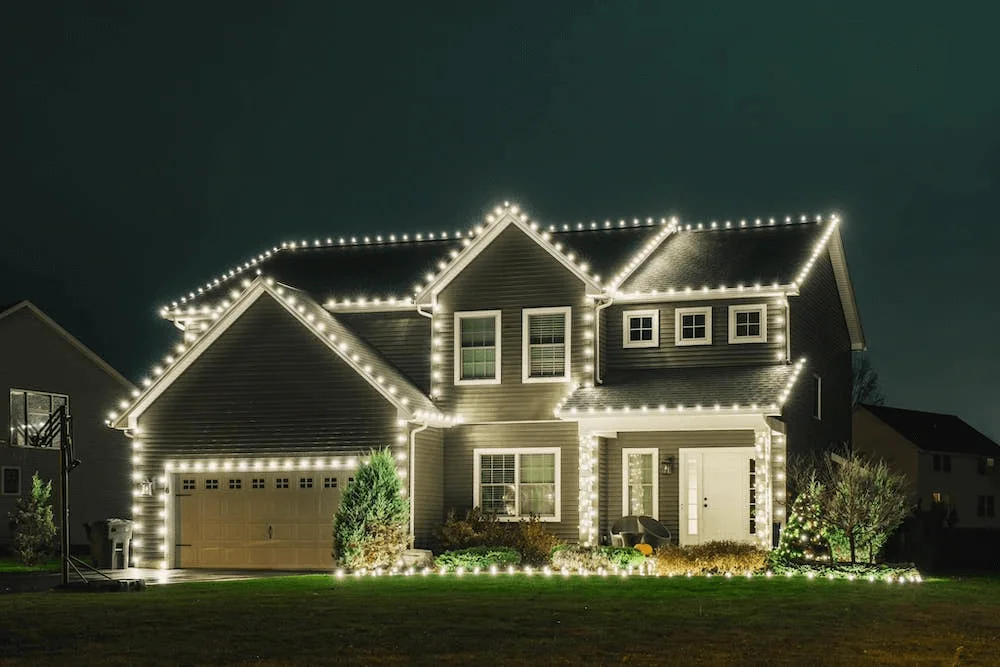
The best Christmas light installer is not simply the company with the lowest price or the most lights in a photo. Look for a company that can explain the design, define what is included, work safely around the property, support the display during the season, and tell you exactly what happens after the holidays.
1. Start with a property-specific design
A useful installer should ask about the property, preferred appearance, important viewing angles, timeline, and budget. Rooflines, peaks, columns, windows, entrances, greenery, trees, and landscape elements should form one composition. Be cautious when a quote jumps directly to a package without explaining which areas it covers.
The design does not need to be a photorealistic rendering, but it should make the scope understandable. You should know what is included, what is optional, and whether both sides are discussing the same result.
2. Confirm the business and insurance details
Ask for the company’s legal business name, contact information, and proof of current insurance appropriate to the work. Clarify who will be on the property and whether subcontractors are used. Insurance is not a substitute for careful work, but it is a basic part of evaluating a company that will use ladders, lifts, electrical products, and attachment methods around your home or business.
3. Ask what products and installation methods are used
“Commercial-grade” is not enough detail. Ask whether the product is outdoor-rated, how roofline spacing is kept consistent, how bulbs or sections are repaired, what clips or attachment methods are used, and how cords and connections are routed. A professional should be able to explain the approach in plain language without requiring the customer to become an electrician.
The U.S. Consumer Product Safety Commission recommends safety-tested products, inspection for damaged wiring, outdoor-use ratings, and GFCI-protected receptacles for exterior holiday lighting. An installer’s power and connection plan should respect product limits and property conditions.
4. Understand the service model
Some companies sell and install lights. Others lease or provide the display as part of an annual service. Some include in-season maintenance, removal, and storage; others price those separately. There is no single correct structure, but the quote should state it clearly.
- Who owns the lighting and custom materials?
- What happens if a section stops working?
- Is an in-season service call included?
- When and how is removal scheduled?
- Where and how is the display stored?
- What should the customer expect next season?
5. Compare reviews for patterns, not perfection
Look for repeated comments about communication, installation quality, responsiveness, respect for the property, and follow-through after the season. A large collection of generic praise is less useful than detailed reviews that describe the service you are considering. Check the most recent reviews and note how the company responds when a customer raises a concern.
6. Evaluate the quote, not only the price
Two quotes may appear to cover “the roofline” while including different footage, peaks, lamps, greenery, service, removal, or storage. Compare line by line. Ask whether optional areas are separated from the base design and what could be adjusted if the design exceeds the target budget.
Price can also reflect access. A steep or high roofline, difficult surfaces, lifts, large trees, operating-hour restrictions, and commercial coordination change the work even when two properties look similar from the street.
7. Plan early enough to protect your options
Christmas lighting is seasonal, and installation capacity is finite. Earlier requests usually allow more time for design revisions, material planning, property approvals, and preferred installation windows. Businesses, associations, and managed properties should also account for internal approval and vendor requirements.
Red flags worth taking seriously
- No clear business identity or reliable contact information
- Unable or unwilling to provide proof of insurance
- A vague quote that does not identify the lit areas
- No answer about maintenance, removal, or storage
- Pressure to approve before the scope is understood
- Unsafe-looking ladder, electrical, or attachment practices
- Photos that cannot be connected to the company’s actual work
A simple comparison checklist
| Question | Why it matters |
|---|---|
| Is the design specific to this property? | Prevents mismatched expectations. |
| Is the company insured for the work? | Establishes a basic professional safeguard. |
| What products and methods are used? | Affects appearance, safety, repair, and durability. |
| What happens when lights fail? | Defines the in-season support experience. |
| Are removal and storage included? | Reveals the true full-season cost. |
| What exactly is in the quote? | Allows an honest comparison. |
Brightify provides property-specific residential and commercial Christmas lighting designs across Northeast Ohio. The quote process separates property type from service interest and includes a “Not sure” choice, so a visitor is never forced into the wrong lighting path.
Frequently asked questions
When should I contact a Christmas light installer?
Earlier is better, especially for large homes, commercial properties, associations, custom designs, or preferred installation timing. A request can still be worthwhile later, but choices may narrow as schedules fill.
Should an installer provide a free quote?
Policies vary. What matters is that the quote clearly defines the proposed design, service, price, and next steps before you approve the work.
Should I hire the cheapest Christmas light installer?
Not without comparing scope. A lower quote may exclude lighting, maintenance, removal, storage, peaks, greenery, or other elements included elsewhere.