
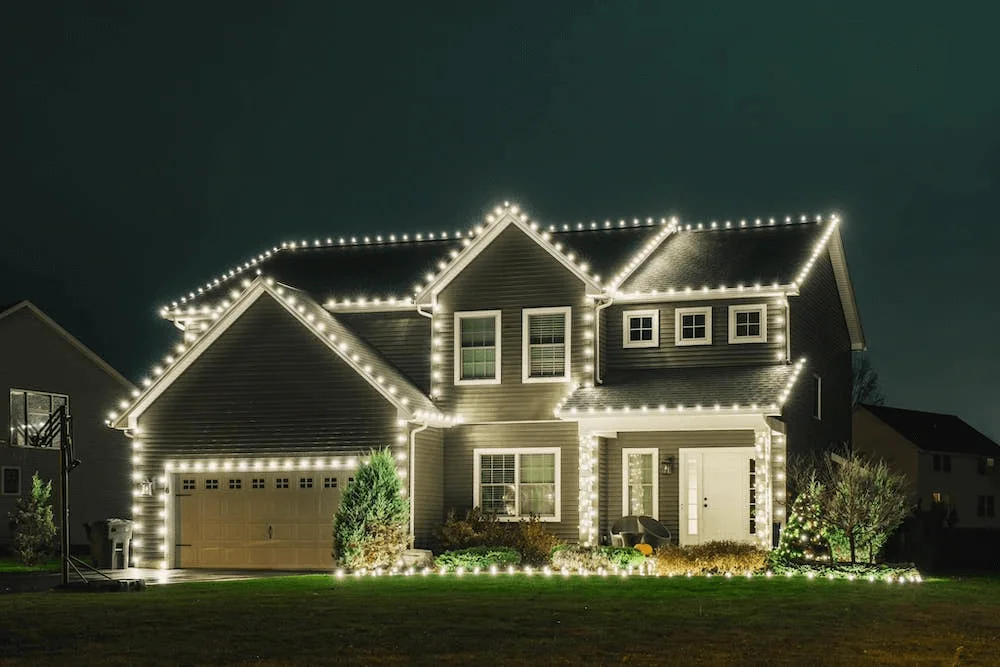
DIY Christmas lights can make sense for a small, ground-accessible display and a homeowner who enjoys the work. Professional installation makes more sense when the design is large, access is difficult, time is limited, or the customer wants one company to manage materials, installation, repairs, removal, and storage. Compare the whole season—not only the first afternoon.
What DIY really includes
A DIY budget begins with lights, but it may also include clips, extension cords, timers, outdoor-rated connections, replacement lamps, storage containers, a ladder, and tools. The time budget includes measuring, shopping, testing, installing, troubleshooting, removing, sorting, and storing. If part of the display fails, the homeowner is also the service department.
For a porch, wreath, shrubs, or a simple one-story line, that may be a satisfying annual project. DIY becomes less attractive as roof height, pitch, weather, large trees, electrical load, and the number of visible transitions increase.
What professional service can include
A full-service installer may provide a custom design, commercial-style products, installation, timers or controls, in-season maintenance, scheduled removal, and organized storage. Companies structure ownership and service differently, so read the proposal rather than assuming every item is included.
The main value is coordination. The customer approves a result and a service plan instead of managing every component separately. That can be especially useful for commercial properties where employees should not be assigned ladder work or where installation must fit around customers and operating hours.
Safety changes the calculation
Holiday decorating involves falls, electrical products, cold weather, and sometimes wet or icy surfaces. The Consumer Product Safety Commission consistently identifies ladder caution, intact wiring, outdoor-use ratings, and GFCI protection as important holiday-safety practices. Hiring a company does not eliminate risk, which is why insurance, methods, training, and site planning belong in the comparison.
A homeowner considering DIY should honestly assess ladder height, ground conditions, overhead hazards, roof pitch, wind, temperature, and whether another adult can assist. If the plan requires improvising access or electrical connections, reduce the scope or hire qualified help.
Design quality: product vs. execution
Professional-looking results come from consistent spacing, straight lines, balanced focal points, clean transitions, hidden wire where practical, and restraint. Expensive lights installed without a plan can still look scattered. A modest display designed around the architecture can look polished.
DIY homeowners can improve results by measuring first, testing a sample color at night, choosing one primary focal line, and avoiding unrelated lamp colors or spacing on the same elevation. Professionals should be able to show how the proposed elements create one composition.
Full-season comparison
| Factor | DIY | Professional service |
|---|---|---|
| Up-front cash | Often lower for a small display | Higher because labor and service are included |
| Time | Homeowner manages every step | Installer manages the approved scope |
| Design | Based on homeowner planning and retail options | Can be measured and tailored to the property |
| Access | Limited by homeowner equipment and comfort | Planned with professional ladders or access equipment |
| Repairs | Homeowner diagnoses and fixes | May include in-season service |
| Removal and storage | Homeowner handles both | May be included in the service |
When DIY is a reasonable choice
- The display is small and reachable from the ground or a low, stable ladder.
- You already own compatible outdoor-rated products and safe equipment.
- You enjoy the installation and have time for repairs and removal.
- The power and connection plan follows product instructions.
- You are willing to reduce the scope when weather or access is unsafe.
When professional installation is likely worth it
- The roofline is high, steep, complex, or difficult to access.
- You want a measured, cohesive design rather than fixed retail lengths.
- The display includes large trees, multiple elevations, or commercial coordination.
- You do not want to own troubleshooting, removal, and storage.
- A defined seasonal service is more valuable than minimizing the first-year price.
Compare the quote against the job you would actually do
Do not compare a full-service proposal with the price of a few boxes unless both create the same display. Estimate the products, clips, cords, timers, tools, storage, replacement items, and your time. Then compare the professional scope line by line. Brightify’s Christmas light installation cost guide explains the property conditions that can change a quote.
Frequently asked questions
Is professional Christmas light installation worth it?
It can be when difficult access, design quality, time, maintenance, removal, and storage matter. For a simple ground-level display, DIY may still be the better fit.
Do professional installers provide the lights?
Many do, but ownership and service models vary. Confirm whether products, installation, maintenance, removal, and storage are included in the quote.
Can I install the lower areas and hire a professional for the roofline?
Possibly. Ask the installer how homeowner-supplied elements affect design, electrical planning, service boundaries, and responsibility for repairs.