
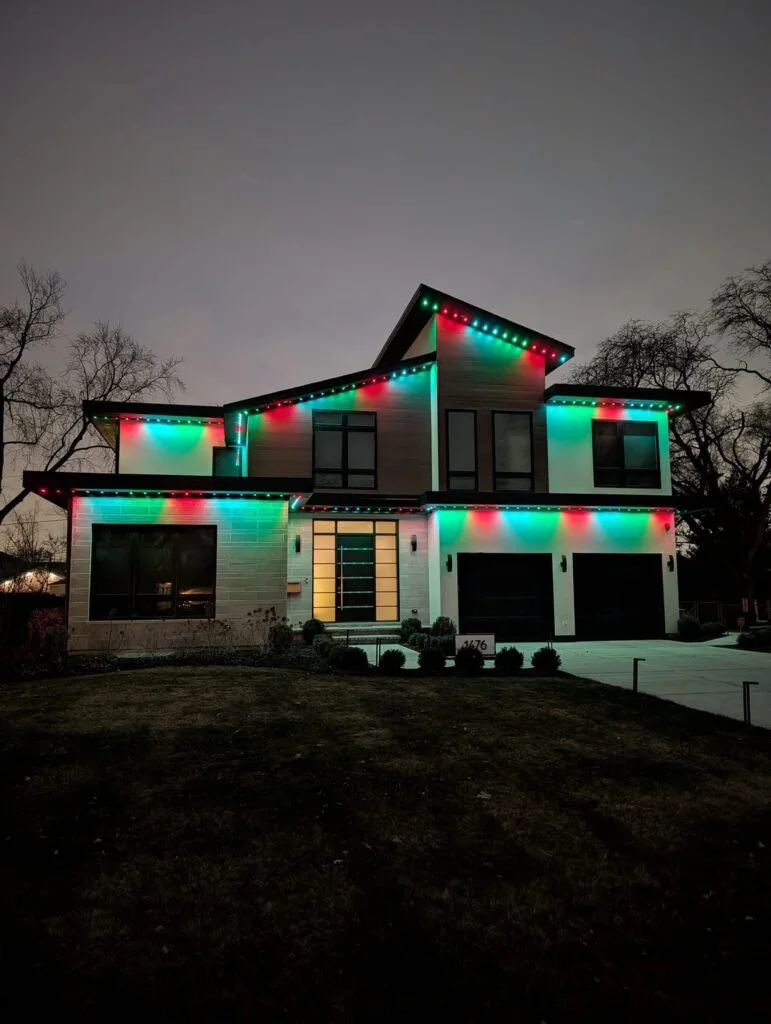
Exterior roofline lighting can mean several different things: permanent color-changing lights tucked near the eaves, seasonal Christmas lamps attached for a few months, or fixed architectural fixtures that wash the soffit and façade. Defining the goal first prevents homeowners from comparing systems that solve different problems.
Permanent roofline, soffit, and eave lighting
Homeowners use “permanent roofline lights,” “permanent soffit lights,” “eave lights,” and “trim lights” to describe overlapping products. In Brightify’s service, permanent outdoor lighting means a low-profile system installed along selected architectural lines and controlled by an app for everyday white light, holidays, celebrations, and scheduled scenes.
The exact mounting location depends on the home and system. Some installations sit beneath the eave or near the soffit; others follow fascia or trim details. The important questions are where the light points, how the channel looks during the day, how wires and transitions are handled, and whether the chosen line creates the nighttime effect you want.
Permanent lights vs. seasonal Christmas lights
Permanent lights remain installed and can change appearance throughout the year. Seasonal Christmas lights are designed around a holiday display, then removed and stored. Seasonal service can include roofline lamps, wreaths, garland, trees, shrubs, and landscape elements that a permanent roofline system does not replace.
If the goal is “I never want to hang roof lights again,” permanent lighting may be attractive. If the goal is a rich Christmas composition with greenery and temporary focal elements, seasonal service may be the better fit. Some properties use both: permanent lighting for architectural color and temporary greenery or trees for the holiday season.
Compare permanent and seasonal lighting in detail.
Design the lighting in zones
Breaking the house into zones makes the plan easier to evaluate. Common zones include the main front roofline, upper peaks, garage, porch, entrance, side elevation, rear entertaining area, and detached structures. Not every zone needs lighting. The most visible lines should establish the design before secondary areas are added.
Zones also make controls more useful. A homeowner may want a subtle warm-white front roofline every evening, colors on the peaks for an event, and no lighting on the rear zone after a certain hour. Ask whether the system supports independent control and how easy it is to save reliable scenes.
Daytime appearance matters
A permanent system is visible more hours with the lights off than on. Review channel color, mounting line, corner transitions, wire routes, controller placement, and how the system crosses architectural interruptions. Product photos often focus on nighttime color, so ask to see close daytime examples as well.
“Invisible” is rarely a realistic promise. A better goal is a clean, low-profile installation that follows the architecture and does not call attention to itself from normal viewing distance.
White light deserves a real demonstration
If you want year-round architectural white, do not evaluate the system only through animated colors. Compare warm-white quality, dimming, beam pattern, spacing, and how the light falls on the wall. Pixel-based roofline systems can create a dotted or scalloped effect that is different from traditional downlights. Neither is universally better; they create different aesthetics.
Controls, network, and ownership
- Who will have access to the app and controller?
- Can schedules run without a phone being nearby?
- How are zones named and saved?
- What happens after a router, phone, or account change?
- Can the system be transferred to a future homeowner?
- Who provides support if a controller or section stops responding?
Ask the installer to include orientation and a few useful scenes. A technically capable system has little value if ordinary family members cannot use it confidently.
Installation planning
A design review should consider measured footage, roof height and pitch, access, mounting surfaces, peaks and returns, power, controller location, wire routing, network reach, landscaping, and future service access. Northeast Ohio weather adds rain, snow, ice, wind, temperature swings, and freeze-thaw cycles, so attachment and component placement matter.
Commercial properties add operating hours, customer or tenant traffic, lifts, decision-makers, signage, and approval timing. Brightify offers a separate commercial permanent lighting service for those needs.
What affects permanent lighting cost?
Linear footage is only the beginning. Height, peaks, complexity, access, channel and product, power work, controllers, zones, routing, and installation time can change the scope. A design and quote should identify the covered lines and separate optional additions. See the permanent outdoor lighting cost guide for a fuller breakdown.
Questions to ask before approving a system
- Which exact rooflines and elevations are included?
- Where will the channel, wire, controller, and power components be placed?
- How does the system look in daylight?
- What kind of white light does it produce?
- How are zones, schedules, and saved scenes controlled?
- What product, labor, and support warranties apply?
- Who handles troubleshooting and replacement components?
- What information should be kept for a future owner?
Brightify creates custom residential permanent outdoor lighting designs for Northeast Ohio homes. You can begin without knowing the system details; the address and goals are enough to start the conversation.
Frequently asked questions
Are permanent roofline lights the same as soffit lights?
The terms overlap in everyday searches, but products and mounting locations vary. Ask where the system will be mounted, how it directs light, and how it appears during the day.
Can permanent lights produce normal warm white?
Many systems offer a white-light setting, but color quality and beam pattern vary. View a real nighttime example before choosing a system for everyday architectural lighting.
Do permanent lights replace Christmas lights?
They can replace temporary roofline color for some homeowners, but they do not automatically replace wreaths, garland, tree lighting, or other seasonal display elements.