
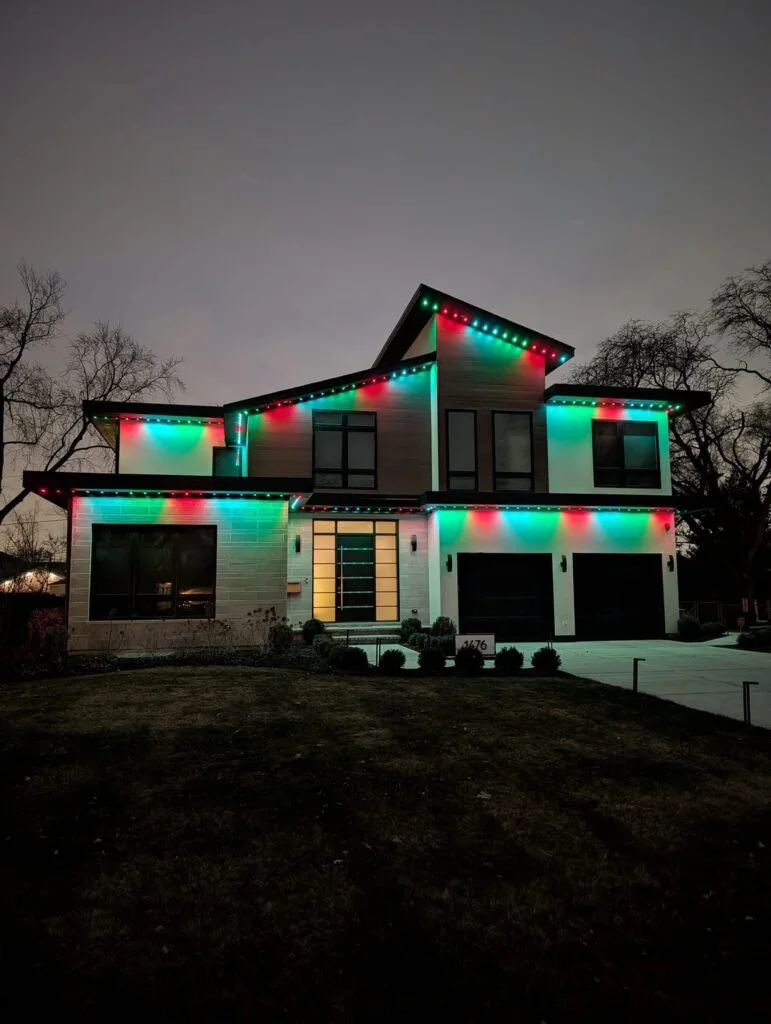
A professionally installed permanent roofline lighting system commonly requires a several-thousand-dollar investment. As a broad planning guide, focused residential projects may begin around $2,000 to $4,500, larger or multi-level homes often fall around $4,500 to $8,000 or more, and complex commercial properties require a custom scope. Footage matters, but it is only one part of the price.
Permanent outdoor lighting cost ranges
| Illustrative project | Planning range | Typical scope considerations |
|---|---|---|
| Focused residential roofline | About $2,000–$4,500 | Selected front-facing lines, relatively simple access, limited zones, and a straightforward control plan |
| Larger or multi-level home | About $4,500–$8,000+ | More footage, peaks, returns, garages, upper elevations, multiple zones, or more difficult access |
| Complex residential or custom property | About $8,000–$20,000+ | Extensive coverage, detached structures, complex routing, many elevations, or specialized access and power needs |
| Commercial or managed property | Property-specific | Building scale, lifts, controls, operating constraints, approvals, multiple users, and installation coordination |
Some homes will fall outside these ranges in either direction. A short, accessible line can cost less; a tall or architecturally complex property can cost more even when its visible frontage looks modest from the street.
What determines permanent lighting cost?
Measured roofline and architectural complexity
Installers need to measure the exact lines included in the design. Peaks, dormers, corners, returns, elevation changes, garages, and detached structures require different amounts of channel, wire, lights, and labor. The most effective proposal labels the included lines instead of describing the job only as “the front of the house.”
Height and access
Roof height, slope, landscaping, ground conditions, lower roofs, and equipment access affect how the installation can be completed. A lift may be appropriate for a commercial façade or a tall residential elevation. Safe access and careful routing take time, and that time is part of the scope.
Product, channel, and daytime appearance
Permanent lighting remains on the property year-round, so the installation should be evaluated with the lights off as well as on. Product spacing, channel color and profile, transitions, corners, visible wire, and mounting location all affect the result. A low bid is not a good value if the channel distracts from the architecture every day.
Controllers, zones, power, and network reach
A simple front roofline may use one straightforward control plan. Larger properties may need independent zones, longer routing, additional power planning, or multiple users and schedules. Ask where the controller and power components will be placed, how the system connects, and what happens after a router or phone changes.
Commercial coordination
Businesses, associations, venues, and managed properties may add lifts, customer or tenant traffic, installation-hour restrictions, decision-makers, signage, and approval requirements. Commercial permanent lighting should support a defined purpose—such as everyday architectural light, seasonal color, events, or branding—rather than adding effects without a plan.
What should a permanent-lighting quote show?
A useful quote should connect the price to a visible, operable system. Before approving it, confirm:
- The exact rooflines, peaks, entrances, garages, and elevations included
- The product, spacing, channel, and general mounting location
- Where controllers, power supplies, wire routes, and transitions will be placed
- How many zones are included and which areas they control
- Whether schedules and saved everyday scenes will be configured
- What product, labor, and support terms apply
- Who controls the account and how access transfers to a future owner or manager
- Which additions are optional and how they change the price
Do not compare proposals on footage alone unless the products, coverage, channel, controls, zones, access assumptions, and support are also comparable.
How to evaluate the value—not only the price
Permanent lights are a long-term exterior improvement, but that does not guarantee a specific lifespan, resale value, energy savings, or payback period. Those outcomes depend on the selected system, usage, maintenance, future repairs, and what you would otherwise spend on seasonal lighting.
A better evaluation begins with use. If the property will use warm-white architectural lighting several nights a week, holiday colors, event scenes, and schedules, the system may deliver more value than one used only in December. If the goal is a rich Christmas display with greenery and wrapped trees, permanent roofline lights may be only one part of the result.
Ask for a nighttime demonstration of the white-light quality and beam pattern. Pixel-based systems can create a dotted or scalloped effect that differs from conventional downlighting. Neither appearance is automatically better, but the customer should see the difference before installation.
Can permanent lights be installed in phases?
Often, yes. A property can begin with the most visible front roofline and add side elevations, a garage, an entrance, or a rear entertaining area later—provided the system and original control plan support expansion. Discuss the long-term vision during the first design so power, controllers, zones, and transitions do not create avoidable rework.
Permanent lights vs. seasonal Christmas lighting cost
Permanent lighting is normally a larger up-front purchase. Seasonal Christmas lighting is a recurring service that may include a custom holiday design, supplied lights, installation, in-season support, removal, and storage. The services are not interchangeable: permanent roofline lights do not automatically create wreaths, garland, tree lighting, or a traditional removable-bulb appearance.
Do not rely on a generic “break-even” promise. Compare the actual permanent proposal with the seasonal design and service you would realistically purchase, then consider how often you will use the permanent system outside the holidays. The permanent vs. seasonal guide provides a side-by-side framework.
How Brightify creates a permanent-lighting quote
- Share the property. The ZIP code and complete address identify the project and give Brightify the location needed to begin the design.
- Define the goal. Explain whether everyday warm white, holidays, events, team colors, or commercial schedules matter most.
- Review the architecture. Brightify considers rooflines, access, power, routing, zones, and the elevations that create the strongest result.
- Review the free design and quote. The proposed coverage and scope are presented before work is approved.
Frequently asked questions
How much do permanent outdoor lights cost per foot?
Per-foot estimates can be a rough comparison tool, but they often omit peaks, corners, height, access, channel, controllers, power, zones, routing, and support. Request a measured design so the price is tied to the same scope.
Do permanent lights increase home value?
They may appeal to some future buyers, but Brightify does not promise a specific resale return. A clean daytime installation, transferable controls, documented components, and useful white-light scenes can make the system easier for a future owner to understand.
Can permanent lights look like normal warm-white architectural lighting?
Many systems offer warm-white scenes, but color quality, spacing, dimming, and beam pattern vary. View a real example at night rather than judging the system only by color effects.
Can I request only the front roofline?
Yes. A focused design can prioritize the most visible elevation, and optional areas can be identified separately when the system supports future expansion.